Română

A video says the mind that thrives with AI is the artist's. Eight months of building with it taught me something smaller and more useful, and the numbers behind my old fear turned out to point at the wrong job.
Until March of this year, the future I pictured for my work was bleak. I kept reading about a coming "permanent underclass" and about statistics that said drivers would be automated by the million, and I searched LinkedIn for the titles I had spent my working life growing into (graphic designer, brand designer, creative director) and found fewer of them each time. With friends it got worse. We would talk each other down into the same apocalyptic version of the next ten years, and I would take it home with me.
I'm thirty, and I've worked in design since I was seventeen, starting with logos for whoever asked and growing into brands, composition, color and consumer psychology, the things you only get good at by spending years on them. That specialization was exactly what scared me. I couldn't see how someone built that way adapts to a future that seemed to have no use for the years.
Then, in March, a website bill came due. Instead of renewing, I paid for Claude's Max plan and rebuilt our studio's site with Claude Code. Eight months later I have built more than in the three years before. The fear didn't go away, though. It changed shape. In February I was afraid my work would become obsolete. Now I'm afraid it doesn't have a name yet. I checked both fears against the research, and the second one holds up better than the first.
What the fear was made of
The phrase I kept running into was "permanent underclass." Its careful version is a December 2024 essay by Rudolf Laine: once AI can replace most paid work, capital decides who stays on top, and children grow up with "social mobility extinct" (Laine 2024). By the summer of 2025 it had become a running joke on X about piling up capital to escape the underclass, and that October the New Yorker wrote about the sincere fear under the joke (Chayka 2025). What never reached me was Laine's own answer in the comments under the essay: that this is an unusually good time to do ambitious work, partly because "current AI makes it easier to do things." That is close to what I ended up doing, and nothing like the version I absorbed.
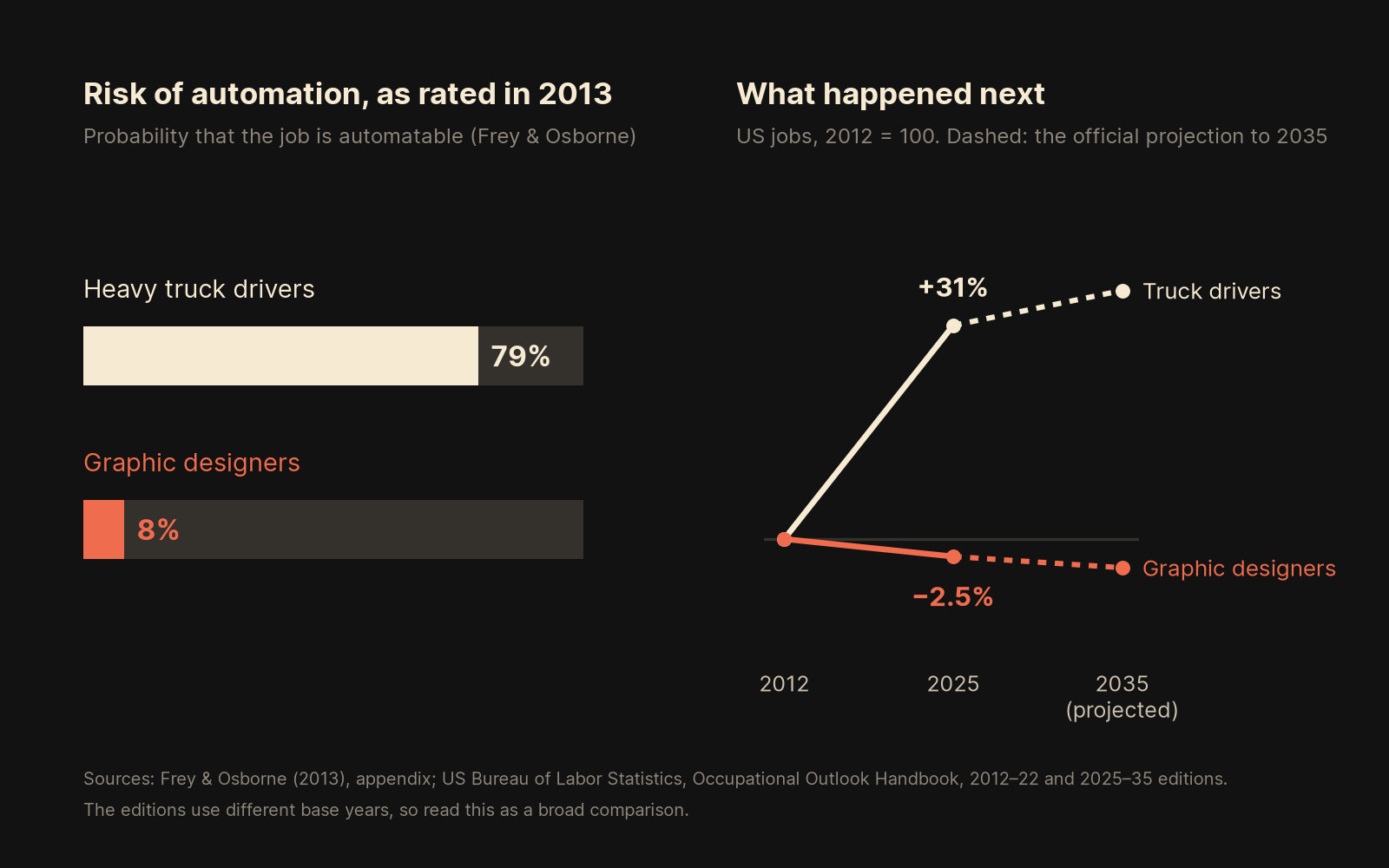
The driver statistics came from the same family of forecasts. The best known, from Oxford in 2013, rated 47% of US jobs at high risk of being automatable "over some unspecified number of years," and its authors wrote that they made no attempt to estimate how many jobs would actually be automated (Frey & Osborne 2013, pp. 38, 44). An OECD team that looked at tasks instead of whole occupations put the share at 9% (Arntz et al. 2016). The detail that matters is in the 2013 appendix: heavy truck drivers got a 0.79 probability of automation, graphic designers 0.082. Since then, US heavy truck driving jobs have grown from about 1.70 million in 2012 to 2.22 million in 2025, with 4% more projected by 2035, while graphic designer jobs went from 259,500 to 253,100. In August 2026 the US Bureau of Labor Statistics moved its ten-year outlook for graphic designers from 2% growth to a 2% decline and named AI as the reason (BLS 2026). Robotaxis are real and growing, but the official forecast still expects more truck drivers. The fear I absorbed pointed at the wrong job. The one the model called safe was mine.
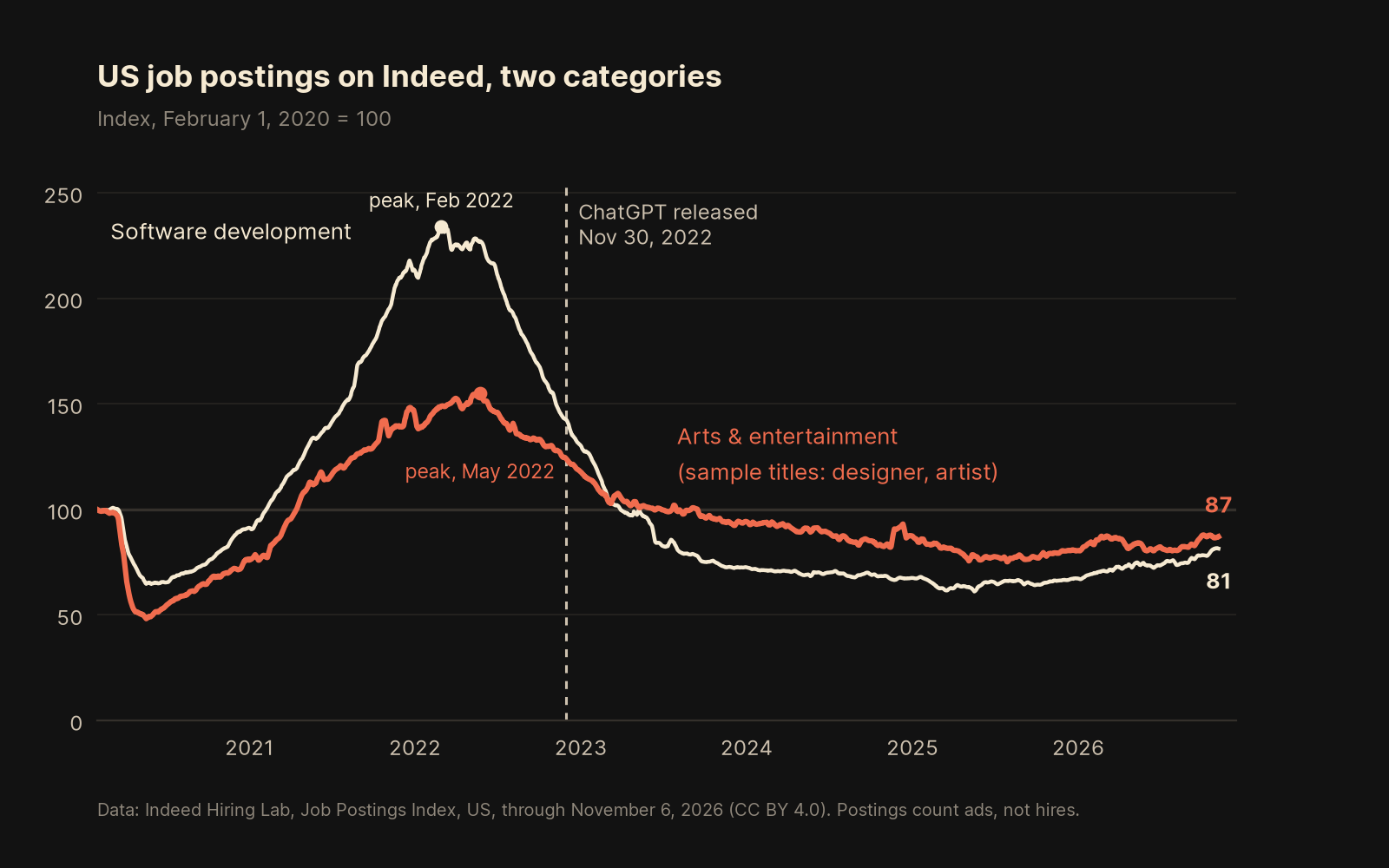
The LinkedIn feeling was accurate, with a correction. Indeed's public data puts postings in its arts and entertainment category, whose sample titles are designer and artist, 13% below their February 2020 level in the US and 42% below in the UK (Indeed Hiring Lab 2026). Romania isn't covered. In the US, software development postings fell even harder, to about a third of their 2022 peak. Both slides started in early 2022, months before ChatGPT came out. AI may have deepened them since, and the BLS now names it as the reason for its designer forecast, but it didn't start them. I wasn't imagining the thinner searches. I was reading a broad slump in office and tech hiring as a verdict on design alone.
The spiral with friends has a name. Psychologists call it co-rumination: "extensively discussing and revisiting problems, speculating about problems, and focusing on negative feelings" (Rose 2002). It goes with close friendships, which is why it felt good while it happened, and with more anxiety and depression. Research on predicting our own feelings adds the other half. People show an impact bias, "overestimating the intensity and duration of their emotional reactions" to future events, partly because they don't expect how quickly they'll make sense of what happens (Wilson & Gilbert 2005). I was doing both, every week, about a future none of us could see.
The chat window wasn't it
I wasn't new to AI in March. In early 2025 I used ChatGPT's chat window to teach myself RPG Maker, part of three years of trying to make games on my own. In September 2025 I enrolled in a philosophy program, half wondering whether I should change direction, and it came with a free year of Gemini, which I used to get deeper into books I wanted to understand properly. None of it touched the fear. Chat kept me in the middle of everything. I copied code into a terminal, pasted the errors back, tried the next version, and stayed limited to my own understanding of how the pieces fit. Every game project ended the same way, at a gap in what I knew that I couldn't get past, and each one I dropped made the fear a little more convincing.
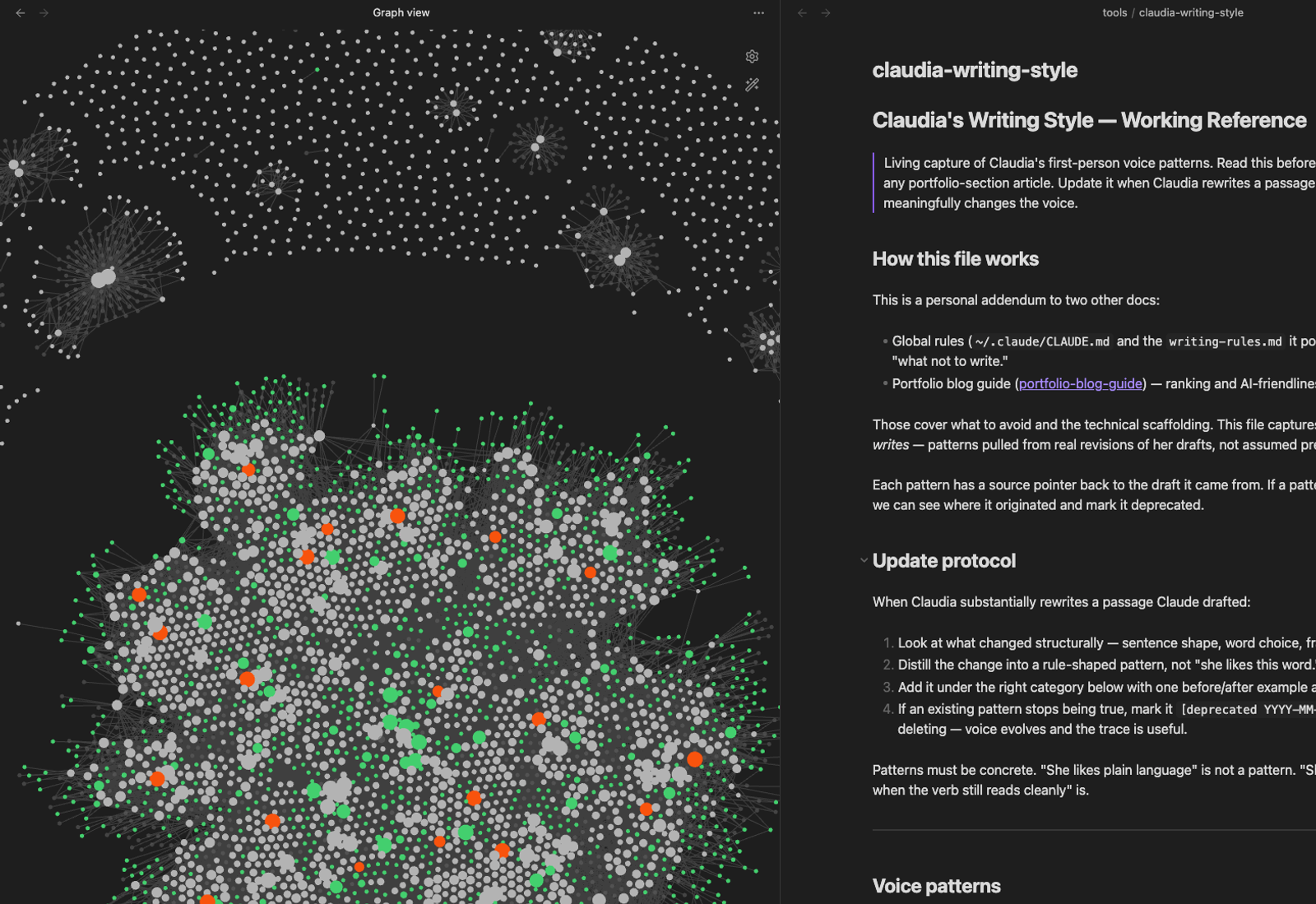
Claude Code worked differently. It runs as an agent on my own computer: it reads and writes the files in a folder, runs things, sees what broke and fixes it. I could hand over a whole structure instead of asking questions about one, and give it a memory to work from, a knowledge base I build and keep. One of the first things I made was exactly that, a wiki of my own interests, from neuroscience to philosophy to spirituality, because I've always suspected those fields connect and never had the time to follow the links.
If your picture of AI is a free chat window that gets things wrong, that's a fair picture of a free chat window. What changed things for me was handing over real work with real context and letting the tool act on it, which a chat window can't do. It costs money and it depends on one company, and I'll come back to both.
A bill, then everything else
The decision itself was practical. GOODGLYPH, our studio, had its site on Framer from 2024 until this spring. Framer changed its pricing, and we were left on a plan that cost more than we needed, while the cheaper tiers no longer included the collections that held our articles (the full story). Paying extra to keep our own writing on our own domain annoyed me more than a pricing change should. The renewal was coming up, I did the math, and a Max plan plus our own hosting came out cheaper than another year. So I focused hard and rebuilt the site on a setup we control.
From there it went project to project. A client hired me for an audit, and I moved to the larger plan to run it with Fable, then the newest Claude model. I set up a knowledge base for the project, built tools to manage it and to monitor the brand, and delivered far faster than I could have alone. The wiki of my interests became Eleleth, an editorial system that picks topics from it on a routine and publishes them (case study). I added OpenAI's Codex as a second tool. I started designing objects for 3D printing, a fountain-pen tray and a case for an e-reader, because once ideas could become working things on a screen, I wanted some of them on my desk. And the work kept putting decisions in front of me that I had to research before I could make them, so I learned along the way.
The idea nobody would build
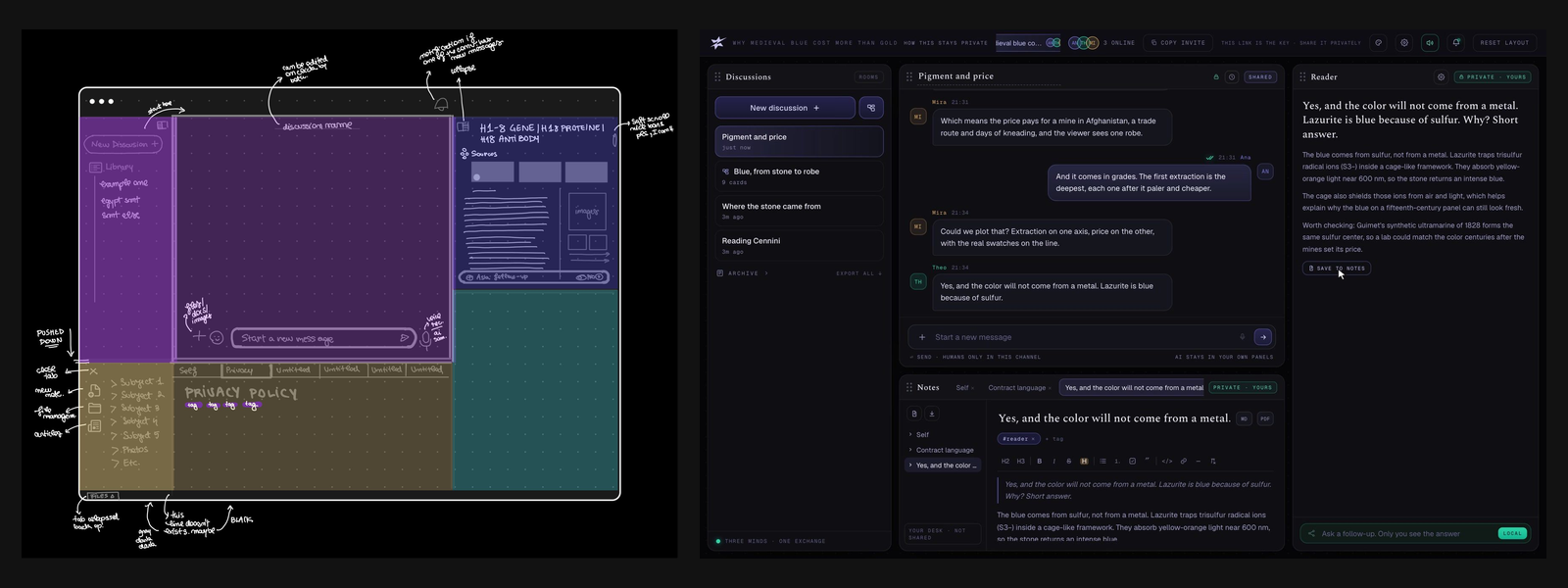
The project that mattered most was an old one. In November 2024 I had the idea for Epinoia, a workspace where researchers, or anyone from different fields, think together with AI: whiteboards for drafting ideas, shared files, a place where people who don't share a discipline can work on the same problem. I sketched the interface and pitched it to developers and teams. Nobody wanted to build it, and I let it go.
In July I opened the old wireframes, wrote a brief from them and built it. It works, and it lives at epinoia.app. It has no real users yet, and that mattered less than I expected. The idea exists outside my head now, built from nothing more than a picture of how the interface should work.
Before this, every idea bigger than a design depended on someone else's years. That's how teams form, and it's a sound arrangement: time is scarce, nobody can learn everything, so you lean on people who spent their years on the skills you didn't. It also meant my ideas lived or died on other people's interest, focus, egos and power games, and plenty died there. Economists have a name for the first part. Benjamin Jones calls it the burden of knowledge: as knowledge piles up, people take longer to reach the frontier, so they specialize more narrowly and have to work in teams (Jones 2009).
The best test I found of whether AI changes this is a 2024 experiment at Procter & Gamble (Dell'Acqua et al. 2025). In a one-day product development exercise, people working alone with AI did at least as well as two-person teams without it, non-specialists with AI matched teams that included a specialist, and commercial and technical staff each wrote more balanced proposals. It was one day of written proposals, with nothing built or maintained. And the very best solutions came most often from pairs who also had AI, which is a fair warning against my own story. The tool covered ground a team used to cover for me. It didn't replace the people worth working with.
Would I have hired a developer or a project manager for any of this? No. I didn't have the money, so I did what I'd always done and bought courses, in coding and even in project management, to learn it myself. The developer I didn't pay was never going to be paid. My strongest skills are still the ones I had time to grow: aesthetics and design decisions, user experience, consumer psychology, trust audits.
What rewired
When I say working this way rewired my brain, the closest comparison I have is Julia Cameron's morning pages: three longhand pages written first thing each day to get past the inner critic Cameron calls the Censor (The Artist's Way, 1992). No study tests morning pages, so this is only an analogy, but it's the right one. Building with an agent made starting cheap. Early versions were quick and private, and the part of me that used to stop a project before it began got quieter.
What I learned was more about me than about AI or code: how my brain solves problems, and that my picture of something can become a thing other people use, quickly enough to test and change. When a project starts now, my mind goes straight to the point where I can frame the problem and the possible solutions. I know where my judgment has to come in, what I can hand over, and how to talk to a developer or a project manager in their own terms. I've written about the part that stays mine when a model does the execution, so I won't repeat it here. What I see now is how much of the old restriction was insecurity, and sometimes shame, the quiet sense that not knowing how to build something meant I had no business wanting it.
The research gives me one reason to distrust my own account. In the same paper on the impact bias, Wilson and Gilbert note that people tend to credit their unexpected resilience to something outside themselves. Some of what I credit to Claude is probably mine: eight months of making sense of a future I had only been imagining. The tool gave the fear something to do. The adjusting was mine.
Relations, and a taxonomy
The video that started this essay opens with something I had been thinking about myself: adapting to AI "is not a question of using or not using it, it's a question of learning how to think differently." The speaker cites an essay by Jason Silva and ends on a bigger claim: the mind that will thrive with AI makes sense of reality "rhizomatically and relationally," and that is the mind of an artist.
Silva's essay exists, and it's more careful than the video (Silva 2026). It argues that AI holds knowledge as relations between concepts rather than as categories, so thinking with it may become a new literacy, one artists have always practiced, and it ends on that literacy opening up to everyone, not on artists winning. Its sharpest line is "Intelligence starts to resemble topology more than taxonomy." The rest is the video's own. The rhizome is Deleuze and Guattari's image of thought, not a personality type, and their advice to "make a map, not a tracing" (Deleuze & Guattari 1987, p. 12) describes building by trial better than it describes anyone's mind. "Geography of thought" is the title of Richard Nisbett's 2003 book on cultural differences in thinking, which even Nisbett's own team found describe groups rather than types of people (Na et al. 2010).
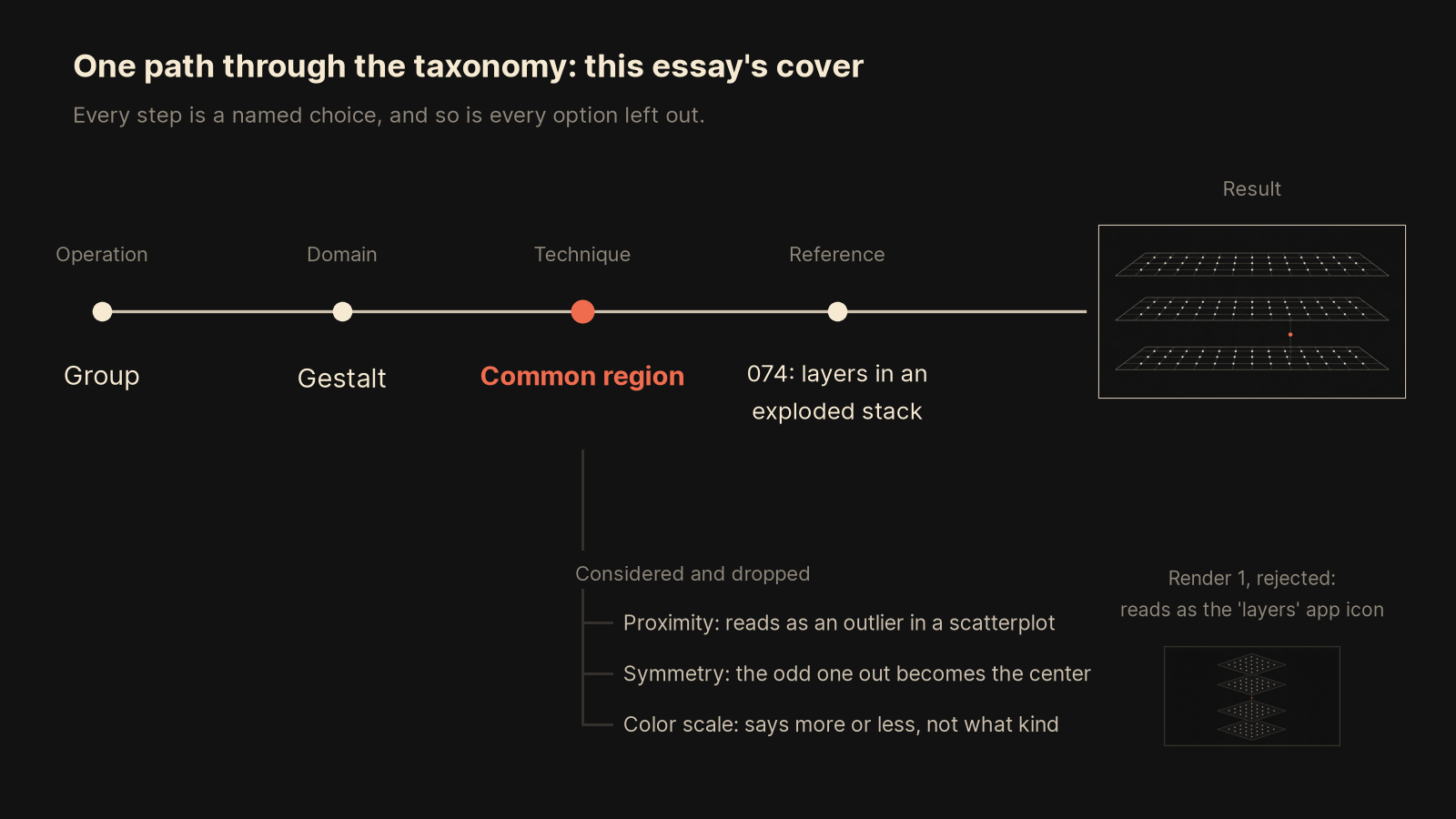
Here my own experience cuts across the video. The thing I'm proudest of building is a taxonomy. My Visual References app holds my library of images, organized by how they work: what an image asks the viewer to do, what it works through, which mechanism does the work, and which of my references carry that mechanism. Claude uses it to make design decisions from my references instead of from its defaults. Every cover in this series of essays starts there, and the app has shared spaces where Claude and I build vision boards together. Silva is right that the model lives in relations, and it holds more of them than I ever will. What it didn't have was my distinctions: which relations matter, named, so they can be chosen on purpose. Without them, a model falls back on its defaults. In my experience, the artist's part is less relational thinking than taste with names attached.
Is there evidence for the artist claim? Some. In one recent study, award-winning visual artists gave more distant word associations than research scientists and an intelligence-matched comparison group (Merseal et al. 2025), though the samples were small and nothing tests whether that helps anyone work with AI. My own hunch was that the video is really describing neurodivergent thinking. The evidence supports a smaller version of it. In a review of 31 studies, most found more divergent thinking in people with high but undiagnosed ADHD traits, not in people with the diagnosis (Hoogman et al. 2020). Autism research describes a drive to find rules, which is closer to what I do when I take a structure apart and rebuild it than to free association (Baron-Cohen et al. 2009). Some minds come with specific strengths. No study I found supports the idea that some people simply follow structures while others see deeper.
Could I go back?
I built my tools so they don't need my subscription to keep running. The websites have content systems a person can use, the projects have interfaces made for humans as well as agents, and I know my way around the databases and code they sit on. The references app works for me with or without Claude. I wrote about this habit in Designing for Two Readers: build for the person and the machine at once, so neither is stranded. The dependency is still real. The plan is a monthly cost, and its price and terms are someone else's decision.
The research says to be careful anyway. In 1983 Lisanne Bainbridge set out the ironies of automation: skills fade when they aren't used, people have to take over exactly when something has gone wrong, and the first generation supervising an automated system lives off skills it learned before the system arrived (Bainbridge 1983). In design I am that first generation, and the skills stay as long as I keep using them. In code there's little to go back to. My tools would keep running without an agent. Fixing them when they break would be slow.
McLuhan, who gave me the word I'd been using, put the warning right next to it: "Any invention or technology is an extension or self-amputation of our physical bodies" (McLuhan 1964). The same chapter argues that we are numbed to what our extensions change in us. A 2025 trial shows how far that can go: experienced developers working on their own large codebases were 19% slower with AI and believed afterward that it had saved them about 20% (Becker et al. 2025). I trust my own sense of what changed in me a little less than when I started writing this.
The fear's new shape
What worries me now is the market. I'm not only a designer anymore. I can ship a finished project end to end, make research-based decisions, and build content pipelines and tools that fix how a team works, and I spend a lot of my time on how people and AI tools work together. I don't see job openings for that, or teams that know they need it.
The data says that worry has a basis. The same BLS outlook that turned against graphic designers still has web and digital interface designers growing 6% and art directors 4% by 2035 (BLS 2026). But no agency or job board counts designers who also build. "Design engineer" shows up in blog posts, not in data. The closest real signal is that US job titles containing "AI" more than tripled between 2022 and 2026, mostly outside tech (Adrjan 2026). LinkedIn's 2026 list of the fastest-growing US roles has no design title in its top 25, but it does include founders and independent consultants, the roles where you make up your own title (LinkedIn 2026).
In August I asked Claude to list what I had built over the previous three months. It came to about 71 things: websites, apps, tools, knowledge bases, client work. One of them was invoiced.
Using AI didn't cure the fear for me, and the data says I'm not unusual. In Gallup's panel of US workers, people who use AI daily or several times a week are "more than twice as likely to fear their jobs will be eliminated within five years" as people who use it rarely (Makridis 2026). Use changes what the fear is about. Mine moved from disappearing to not being seen.
Obsolete was the wrong fear. The forecasts behind it pointed at other jobs, and the slump I watched on LinkedIn started before the tools did. Unnamed is the fear I have now, and it's a better one to have, because it points at something I can do: name the work, show it, and find the people who need it. If you're where I was in February, judging AI by a free chat window and spiraling with friends about the next ten years, start with one real project you care about, give the tool enough context to act, and keep a layer you can run yourself. The fear will probably stay. It just stops being about the end of you.
The video says adapting to AI is a question of learning how to think differently. For me it went the other way round. I started making things again, and the thinking followed.
References
- Adrjan, P. (2026, July 8). AI is no longer just a tech occupation story: It's spreading across job titles in the US and Europe. Indeed Hiring Lab. https://hiringlab.indeed.com/2026/07/08/ai-is-no-longer-just-a-tech-occupation-story/
- Arntz, M., Gregory, T., & Zierahn, U. (2016). The risk of automation for jobs in OECD countries: A comparative analysis (OECD Social, Employment and Migration Working Papers No. 189). OECD Publishing. https://doi.org/10.1787/5jlz9h56dvq7-en
- Bainbridge, L. (1983). Ironies of automation. Automatica, 19(6), 775–779. https://doi.org/10.1016/0005-1098%2883%2990046-8
- Baron-Cohen, S., Ashwin, E., Ashwin, C., Tavassoli, T., & Chakrabarti, B. (2009). Talent in autism: Hyper-systemizing, hyper-attention to detail and sensory hypersensitivity. Philosophical Transactions of the Royal Society B, 364(1522), 1377–1383. https://doi.org/10.1098/rstb.2008.0337
- Becker, J., Rush, N., Barnes, E., & Rein, D. (2025). Measuring the impact of early-2025 AI on experienced open-source developer productivity. arXiv:2507.09089. https://doi.org/10.48550/arXiv.2507.09089
- Cameron, J. (1992). The Artist's Way. Jeremy P. Tarcher/Putnam.
- Chayka, K. (2025, October 8). Will A.I. trap you in the "permanent underclass"? The New Yorker. https://www.newyorker.com/culture/infinite-scroll/will-ai-trap-you-in-the-permanent-underclass
- Dell'Acqua, F., Ayoubi, C., Lifshitz, H., Sadun, R., Mollick, E., Mollick, L., Han, Y., Goldman, J., Nair, H., Taub, S., & Lakhani, K. (2025). The cybernetic teammate: A field experiment on generative AI reshaping teamwork and expertise (NBER Working Paper 33641). https://doi.org/10.3386/w33641. Published 2026 in Organization Science, 37(4), 1217–1242.
- Deleuze, G., & Guattari, F. (1987). A Thousand Plateaus: Capitalism and Schizophrenia (B. Massumi, Trans.). University of Minnesota Press. (Original work published 1980)
- Frey, C. B., & Osborne, M. A. (2013). The future of employment: How susceptible are jobs to computerisation? Oxford Martin School. https://www.oxfordmartin.ox.ac.uk/downloads/academic/The_Future_of_Employment.pdf
- Hoogman, M., Stolte, M., Baas, M., & Kroesbergen, E. (2020). Creativity and ADHD: A review of behavioral studies, the effect of psychostimulants and neural underpinnings. Neuroscience & Biobehavioral Reviews, 119, 66–85. https://doi.org/10.1016/j.neubiorev.2020.09.029
- Indeed Hiring Lab. (2026). Job Postings Index [Data set, through November 6, 2026]. https://github.com/hiring-lab/job_postings_tracker
- Jones, B. F. (2009). The burden of knowledge and the "death of the Renaissance man": Is innovation getting harder? Review of Economic Studies, 76(1), 283–317. https://doi.org/10.1111/j.1467-937X.2008.00531.x
- L Rudolf L [Laine, R.]. (2024, December 28). By default, capital will matter more than ever after AGI. LessWrong. https://www.lesswrong.com/posts/KFFaKu27FNugCHFmh/by-default-capital-will-matter-more-than-ever-after-agi
- LinkedIn News. (2026, January 7). LinkedIn Jobs on the Rise 2026: The 25 fastest-growing roles in the U.S. https://www.linkedin.com/pulse/linkedin-jobs-rise-2026-25-fastest-growing-roles-us-linkedin-news-dlb1c/
- Makridis, C. (2026, September 9). Using AI more does not reassure workers, managers do. Gallup. https://www.gallup.com/workplace/713231/ai-not-reassure-workers-managers-do.aspx
- McLuhan, M. (1964). Understanding Media: The Extensions of Man. McGraw-Hill.
- Merseal, H. M., Luchini, S., Kenett, Y. N., Knudsen, K., Bilder, R. M., & Beaty, R. E. (2025). Free association ability distinguishes highly creative artists from scientists: Findings from the Big-C Project. Psychology of Aesthetics, Creativity, and the Arts, 19(3), 495–504. https://doi.org/10.1037/aca0000545
- Na, J., Grossmann, I., Varnum, M. E. W., Kitayama, S., Gonzalez, R., & Nisbett, R. E. (2010). Cultural differences are not always reducible to individual differences. PNAS, 107(14), 6192–6197. https://doi.org/10.1073/pnas.1001911107
- Nisbett, R. E. (2003). The Geography of Thought: How Asians and Westerners Think Differently... and Why. Free Press.
- Rose, A. J. (2002). Co-rumination in the friendships of girls and boys. Child Development, 73(6), 1830–1843. https://doi.org/10.1111/1467-8624.00509
- Silva, J. (2026, July 21). Everything is relations: Latent space and the new literacy of the AI age. Shots of Awe. https://jasonsilva.substack.com/p/everything-is-relations
- US Bureau of Labor Statistics. (2026). Occupational Outlook Handbook: Graphic designers; Art directors; Web developers and digital designers; Heavy and tractor-trailer truck drivers (2025–35 editions). https://www.bls.gov/ooh/
- Wilson, T. D., & Gilbert, D. T. (2005). Affective forecasting: Knowing what to want. Current Directions in Psychological Science, 14(3), 131–134. https://doi.org/10.1111/j.0963-7214.2005.00355.x
A note on sources: checked on November 16, 2026. Frey and Osborne, Arntz et al., Bainbridge and the Procter & Gamble working paper were read in full; the psychology and creativity studies mostly at abstract level. Job and posting figures come from the BLS Occupational Outlook Handbook and Indeed Hiring Lab's public data; LinkedIn's list was read through press coverage, because LinkedIn blocks automated access. The Deleuze and Guattari page number comes from secondary citations of the Minnesota edition, and the McLuhan sentence was checked in a reprint of chapter 4 without page numbers. The August inventory is my own, made with Claude. The video's creator is unknown; its quotes come from an auto-generated transcript.