Română
My work has a reader I never designed for: the model my clients read it through. A personal piece on making things for a person and a machine at once, and what that does to the job.
Something changed about the work I hand off, and I noticed it before I had words for it.
I send a client a pitch deck. Clean, considered, built to be walked through in a room. Except the room isn't where it goes anymore. It goes into their model. They drop the deck into ChatGPT or Claude and ask it what they should make of it, and the deck starts talking back, in a voice that isn't mine, to a person who isn't in front of me. The first time I clocked this I felt something between fascination and a small, specific unease. My work had gained a reader I never designed for, and that reader had opinions.
For a while I filed it under technical curiosity. It isn't. It's a change in who I'm making things for, and it landed on a tension I've carried my whole working life.
Because here is the thing about me: I have always half-believed that the structure is the real object and the surface is just its face. When I design, I build the bones first, the order of the argument, the hierarchy of the idea, the logic of how one thing gives onto the next, and only then do I dress it. I love the dressing. The type, the color, the feel of a thing. But some stubborn part of me has always suspected that the bones were what actually mattered, and the surface was the part I got to enjoy.
Then a reader arrived that can only see the bones.
A model doesn't have eyes. It can't be moved by a gradient or slowed by a good margin. It reads the structure and nothing else. Feed it a beautifully designed document with no real order underneath, and it comes out the other side with mush. Feed it something plain but truly structured, and it walks straight through. Which means the machine is, in its blunt way, agreeing with the part of me that always thought structure was the truth. It ignores everything I labor over on the surface and reads the thing I built underneath. That is validating and slightly annihilating in equal measure.
So now the pitch deck has two readers. There's the client, and there's the machine the client reads through. And the second one has quietly become a kind of judge, an assistant sitting between me and the person I'm actually trying to reach. My work gets read by a model first, interrogated, summarized, extended, and only then reaches the human, already colored by whatever the machine made of it. A third party has joined the conversation between me and the people I work with, one neither of us hired and neither of us can see. I am not only persuading a person anymore. I am being parsed by the thing they trust to help them think, and I don't get to be in the room when it happens.
That last part is the one I keep turning over. It's a little lonely. You make something with care, hand it to someone, and a machine you'll never meet gets first read. Whatever it decides about your work is already in the client's head before you say a word. You are, in a quiet way, being represented by a stranger.
So I started building for the stranger too.
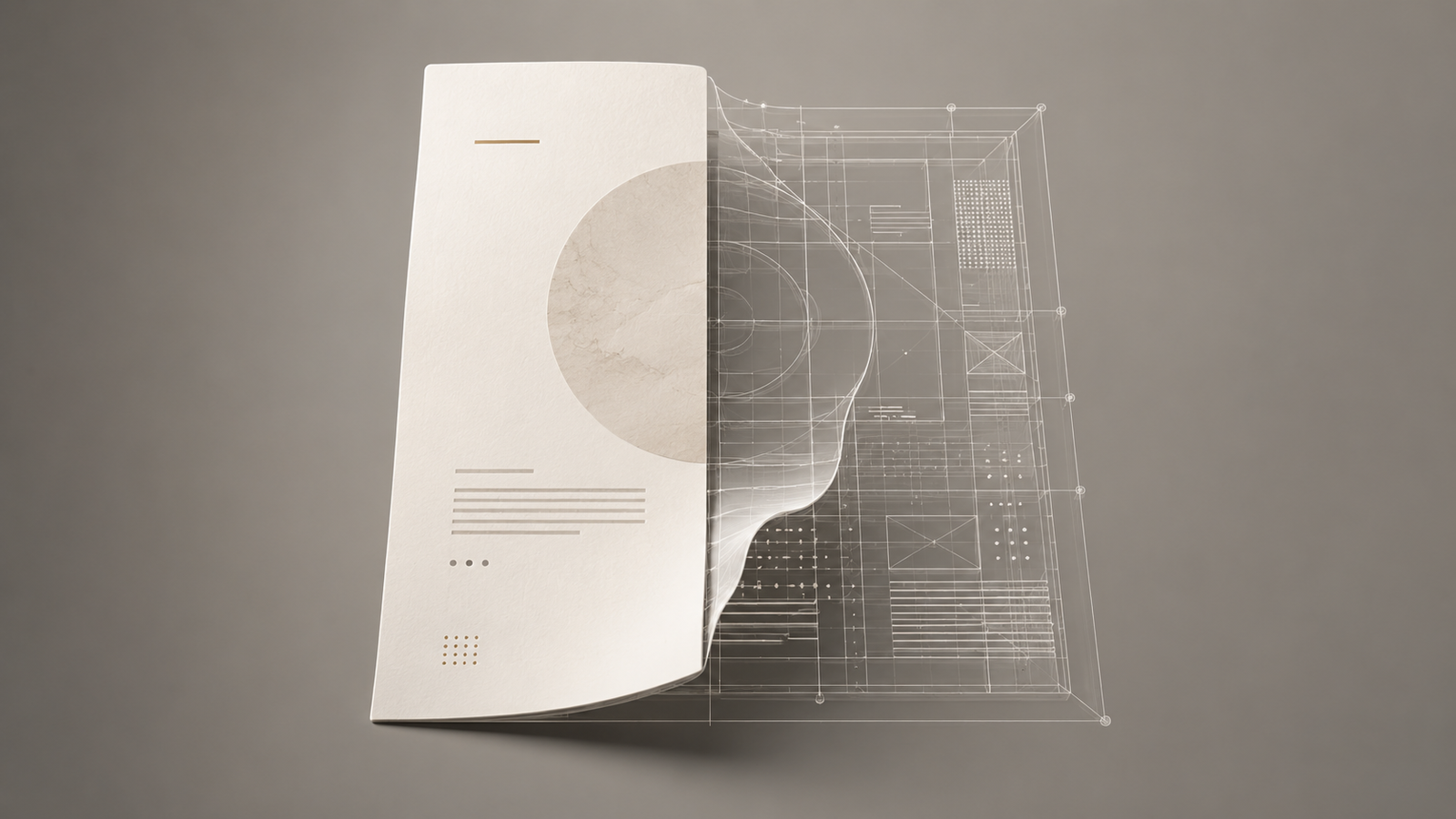
Underneath the surface, I now build a second structure, the one only a machine sees. Clean hierarchy. Meaning that survives being stripped of its styling. A version of every document a model can read as cleanly as a person reads the designed one. The blog I build ships a plain twin of every page, no design at all, just the argument in order, for the reader that has no eyes. It felt strange the first time, making something no human would ever look at, spending real care on a thing with no face. Then it stopped feeling strange, because I realized I wasn't making a second thing. I was exposing the first one. The plain version is the bones I always secretly thought were the point, finally standing on their own.
But if that were the whole story, I could stop designing and just write good structure, and I don't believe that, not even close.
Because a machine can read the structure and still not know who it's talking to. The person on the other side has their own vocabulary, their own world, their own way of understanding what they do. A document full of my language, my frames, my design words, drowns them. So the work has to translate itself, meet them where they already stand, speak in terms they never had to learn from me. And then there's the part I can't hand to any model at all. A machine will answer any question you put to a document. It won't tell you which question you should have asked. It can't feel where you're about to get lost and put a hand on your shoulder three sentences before you do. That is still only mine. The infographic that moves the way understanding moves. The page that carries you through in the right order instead of dumping you at the top of a pile. The map of an argument that lets you see the whole shape before you commit to the first turn. The machine makes the work queryable. Only the design makes it kind.
So both of my old instincts turn out to be right, which is annoying, because I'd half-hoped one would win. Structure is the truth; the machine proved it. And the surface is not decoration, it's the difference between a person being handed something and a person being understood. The two readers want opposite things. Clean structure for the machine wants to flatten, label, make everything explicit. Rich design for the human wants nuance, atmosphere, the meaning that lives in what you leave unsaid. Most days they fight, and I've stopped trying to make them stop.
What I've landed on, if it's a landing at all, is that holding both without letting either one hollow out the other is just the work now. Not a clever synthesis. A discipline. You build the bones honest enough that the machine walks through them clean, and you dress them well enough that the human is carried, not dumped. And underneath both readers there's the same object, the same structure, that existed before either of them arrived and doesn't care which one is looking.
I don't have a tidy place to set this down, and I've noticed I don't want one. What I have is a changed sense of the job and a slightly changed sense of myself. I make things now that keep talking after I leave the room, read by a judge I'll never meet, on behalf of a person I'm trying to reach, in a conversation I'm not part of. It should bother me more than it does. Mostly it's made me more honest. When you know the bones will be read on their own, stripped of everything you used to dress them in, you stop hiding behind the dressing. You just build the thing true all the way down, and trust that if it's true enough, both readers arrive in the same place.