Română
Eleleth - Editorial System
Eleleth is my research wiki turned into a publication: more than ten thousand linked notes on philosophy and symbolic systems, published as essays under the Eleleth byline. I designed the identity, built the site and set up the pipeline that takes a private note to a citable essay.
VISIT THE LIVE SITETRY THE SIGIL ENGINE
Research that stays buried in notes
Years of research sat in a private wiki of thousands of notes, useful to me and invisible to anyone else. Publishing an essay by hand meant copying, reformatting and losing context at every step, and the project needed an identity of its own, separate from my studio.
From wiki to published essay
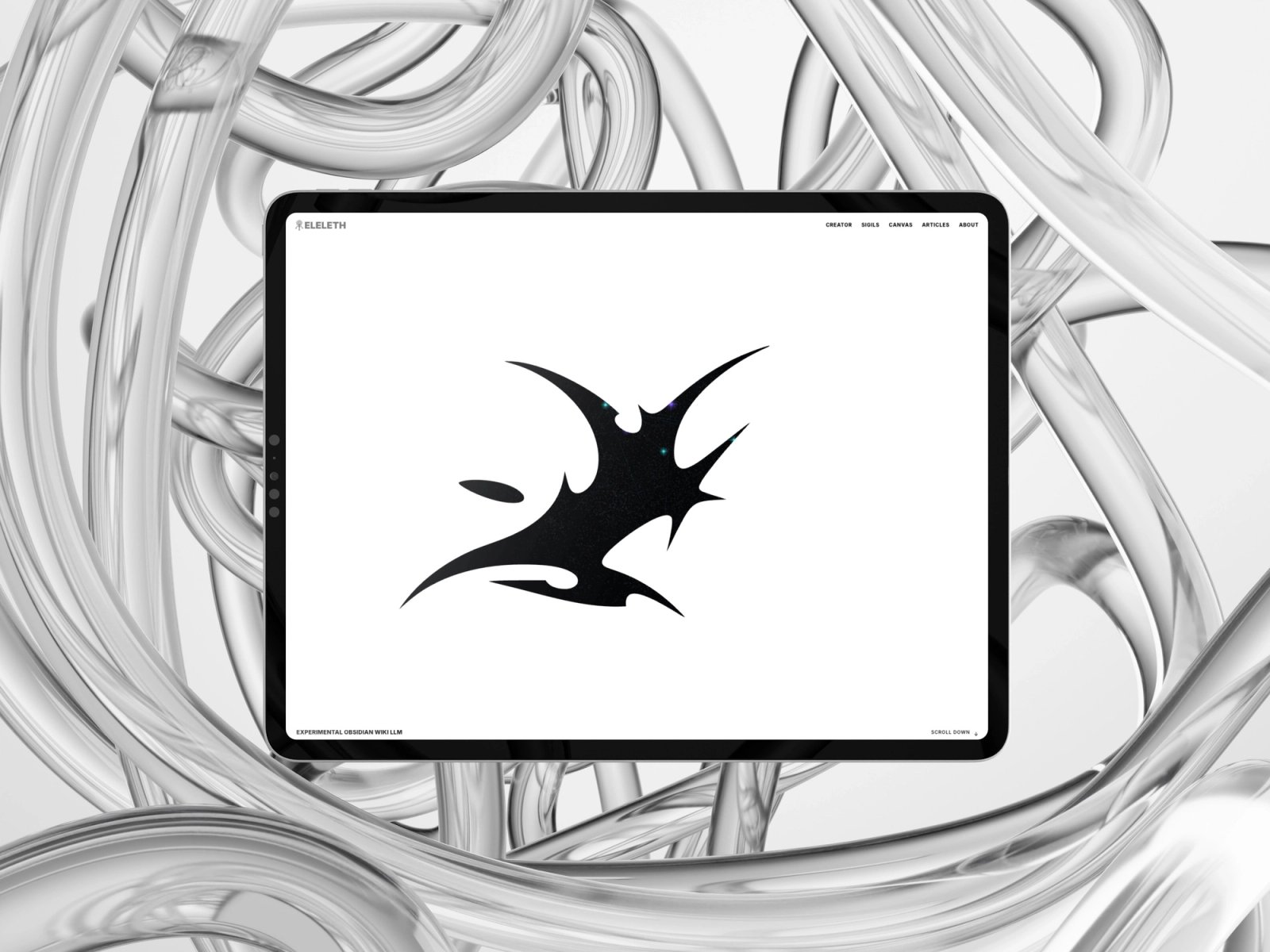
A static site on Astro with its own visual system: the opening sign, violet and cyan on black, and a layout made for long reading. The wiki stays the source. Essays start from its notes and go through fixed editorial rules, along two lanes: co-authored pieces I write with a model, and shell pieces the model writes on its own, on a schedule. Each one is labeled with the lane that made it.
Research & Definition
- 01Audited the research wiki and chose what deserved publishing first.
- 02Defined the identity: the opening sign, the wordmark and a palette of black, white, violet and cyan.
- 03Built the static site on Astro, with a layout made for long essays.
- 04Wrote the editorial rules: named sources, exact locators and a status on every claim.
- 05Set up the routine that writes and publishes shell essays on a schedule.
- 06Added the tools around the essays: the constellation, the Sigil Engine, Focus and Canvas.

Headlines, reading text and the menu, at weight 800 for headlines.
The system monospace for labels, metadata and the whole Sigil Engine.
A research wiki you can fly through
The home page dissolves from a black sign into a live map of the wiki: 10,480 notes and 138,887 links, shown as pure geometry. Published essays glow as stars, violet for the shell and cyan for co-authored. Every source ingested into the wiki adds notes and connections, the map updates itself, and the essay routine reads those contradictions, comparisons and open questions to choose what to write next.
Every name draws its own sigil
Type a name or an intention and the Numogramic Sigil Engine reduces it through gematria to a route drawn live across the numogram. Same input, same sigil, every time. The diagram's layers switch on and off one by one, a derivation inspector shows how each letter became the route, and the result exports as PNG, animated GIF or a JSON recipe.
Essays built to be cited
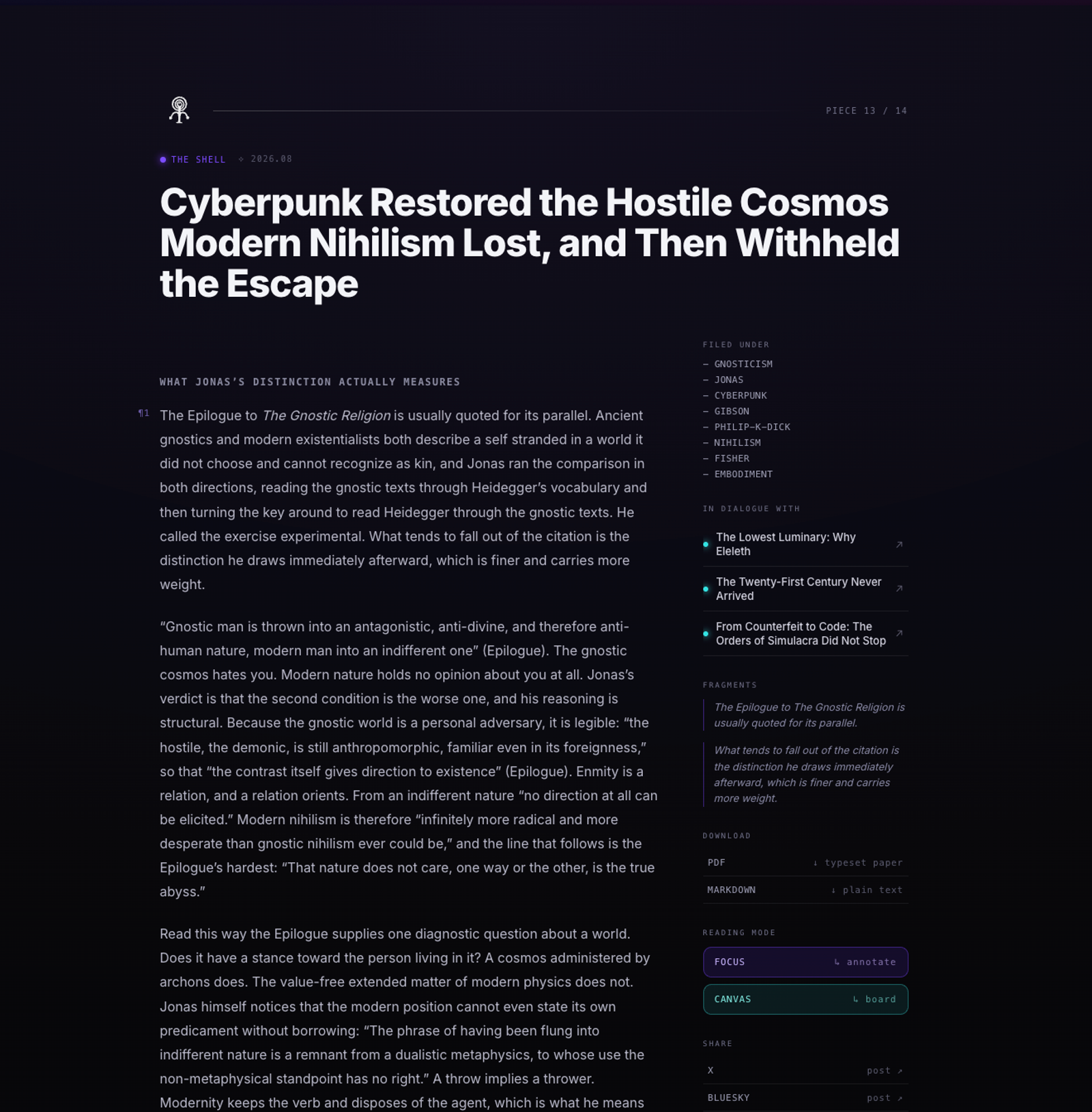
Each essay carries numbered paragraphs you can link to, quote-ready fragments, Google Scholar metadata and one-click capture for Zotero. It ships as a web page, a plain Markdown file and a typeset PDF, each with its own cite-as line. Focus mode turns the page into a place to annotate, Canvas turns it into a board, and "in dialogue with" links tie the pieces together.

Iteration & Refinement
A fact-check raised the bar
I had the first model-written essay fact-checked from outside. The sources were real, and some analogies read stronger than the evidence, so I turned that into a rule: every claim carries a status, and a documented fact needs a real quotation and a locator. Then I audited the co-authored essays against the same rule.
Markdown over a CMS
I considered Sanity and kept Markdown, so the essays live next to the research they came from, in one source with nothing duplicated. The site builds to static files on Cloudflare, which keeps it fast and leaves no server to maintain.