Română

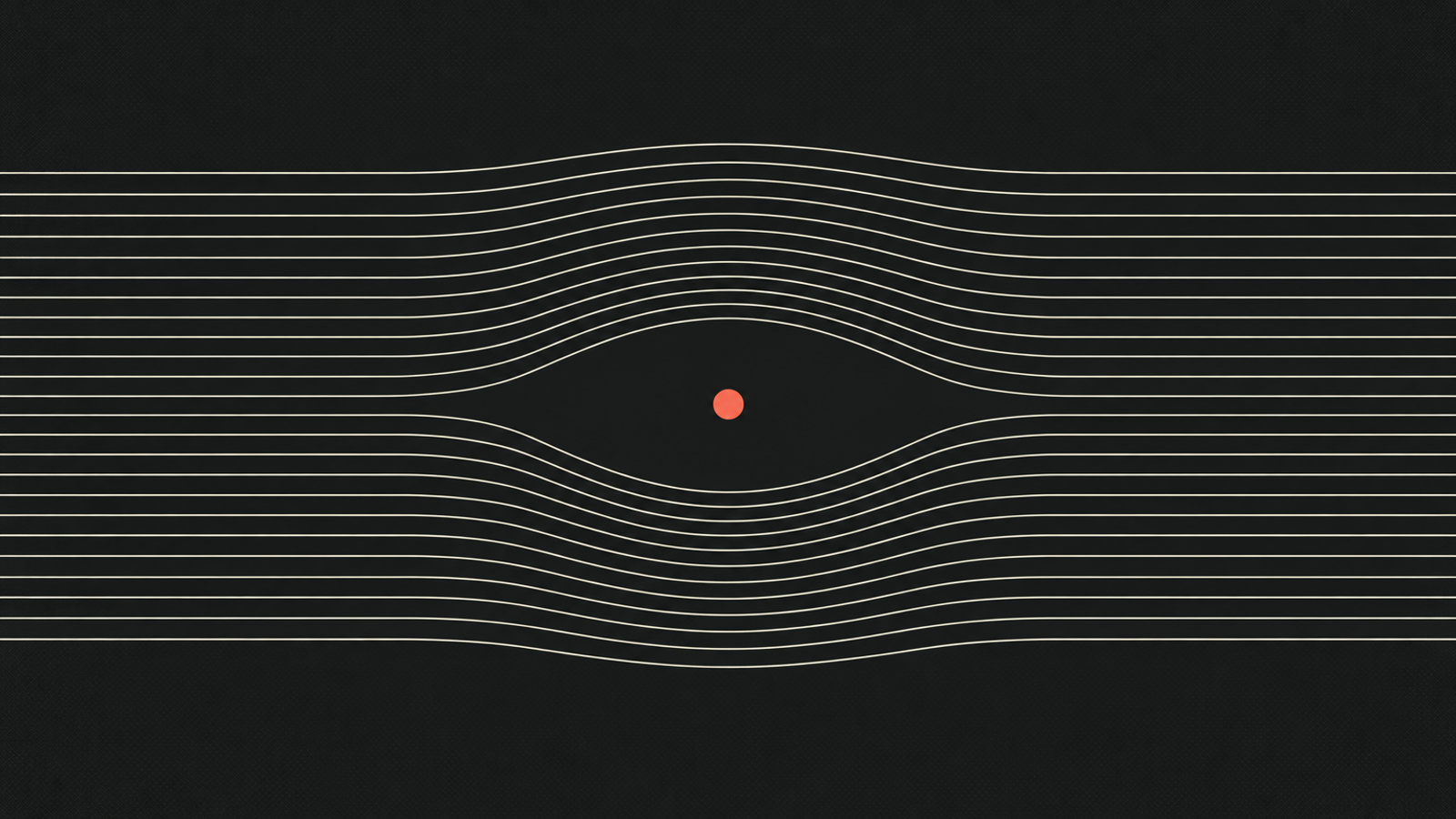
The universe doesn't need an observer to keep running. I wanted a word for the places where it briefly holds one anyway. The research check said the idea is mostly Wolfram, Krakauer and Friston, the word is mine, and the only honest contribution is a definition that could fail.
The universe does not need an observer to keep going. Matter rearranges, energy moves, structures form, hold for a while, and come apart, whether or not anything is watching. That sentence is close to uncontroversial. What I kept circling was the next one. Somewhere inside all that process, at certain scales and for certain stretches of time, the process holds a perspective. A cell does it. A nervous system does it. I do it, for now. We tend to describe that as a second kind of thing appearing on top of matter, a spectator added to the show. I suspect the division says more about how we describe experience than about how the world is built, and that an observer is one of the process's temporary holding patterns, made of the same stuff as everything else.
I wanted a name for the places where that holding happens, and I started calling them observation lock points. Then I did to my own idea what I do to every claim that crosses this site. I have treated my own intuitions as hypotheses to test before, and this one got the full check: every source traced, every claim weighed, and one question asked without mercy. Is any of this new?
The answer was mostly no, and I want to start there, because that answer turned out to be the useful part.
The verdict I didn't want
Three bodies of work already say most of what I was saying.
Stephen Wolfram's Observer Theory (2023) defines observers like us by two features: we are computationally bounded, and we believe we persist, even though underneath we are made of different stuff from moment to moment. An observer, in his account, compresses an overwhelming world into a few stable impressions, with what he calls just enough equivalencing and not too much. My lock points are persistent, bounded, compressing patterns inside a computational substrate. That is close to a restatement. Wolfram's wider framework, the ruliad, is his own metaphysical proposal, which his February 2026 essay summarizes as the claim that the ruliad is everything there ultimately is. Mainstream physics has not accepted it, and nothing here depends on it being true.
David Krakauer, Jessica Flack and colleagues got closer still. In The information theory of individuality (2020), they propose that "individuals are aggregates that preserve a measure of temporal integrity," systems that carry information from their past into their future, and they treat individuality as graded and nested, possible at any scale. When I read that sentence, I recognized my idea in someone else's clothes, already tailored and measured.
Karl Friston's free energy principle for a particular physics (2019) attempts a theory of every "thing" that can be distinguished from other things, each one held apart by a statistical boundary he calls a Markov blanket. Behind all three stand older neighbors: Maturana and Varela's autopoiesis, systems that produce and maintain their own boundary; Evan Thompson's Mind in Life (2007), which argues that life's self-maintenance already carries a minimal perspective; Whitehead's enduring objects as societies of events; Simondon's individual as a stage of an individuation that never finishes.
The term itself is new. The check found no use of "lock point" in consciousness or complexity research. It also found two collisions I hadn't seen. Locked-in syndrome is a medical condition in which a conscious person cannot move, and neuroscience already uses phase locking for neural synchrony. A third problem sits deeper. The best empirical anchor for temporary perspectives is metastability, J. A. Scott Kelso's account of the metastable brain, whose whole point is that the brain coordinates without locking into a fixed state.
So the honest description of what I have is a synthesis with a coined term. A synthesis can still be worth publishing. It just has to earn its one new word.
Five things that keep getting blurred
Most arguments about observers go wrong by sliding between levels, so here they are, kept apart.
The first is the underlying dynamics, whatever the world is doing at its deepest level, which proceeds without needing anyone to watch. Physics hasn't settled what that level is, and I don't need it settled. The second is organized patterns: vortices, convection cells, flames, the ordered structures Ilya Prigogine called dissipative, kept going by a flow of energy. The third is self-maintaining systems, a smaller class that rebuilds its own parts and boundary while its material turns over, with a living cell as the clearest case. The fourth is what I want the lock point to name: a functional perspective, a system that registers differences, carries them forward, and acts on them. The fifth is experience, the fact, if it is one, that there is something it is like to be that system. Some experiencing systems add a sixth: a reflective self-model, the autobiographical "I" that humans run.
Each level is a subset of the one before it, and nothing guarantees the step up. Not every pattern maintains itself. Not every self-maintaining system observes. And not every observer, as far as anyone can show, feels.
What a lock point would have to be
If the term is going to mean anything, it needs a definition that could come out false. Here is the one I am committing to.
A lock point is a region of process where three existing measures cross their thresholds at the same time, measured over the same stretch and at a stated scale. The first is persistence: macroscopic variables stay stable while the microscopic material changes, which is Wolfram's criterion. The second is temporal integrity: the system propagates information from its past into its future more than its surroundings do, which is Krakauer's measure. The third is causal emergence: describing the system as one unit predicts its behavior better than describing its parts. Erik Hoel, Larissa Albantakis and Giulio Tononi showed in 2013 that a macro level can supersede its micro level causally, and Fernando Rosas, Pedro Mediano and colleagues built an alternative measure for the same idea in 2020.
The claim is that these three line up. Where they coincide, a perspective-shaped unit has formed. Where they come apart, as with something persistent that carries no information forward, or emergent without persisting, there is no lock point, only a pattern.
The definition has to be temporary and reversible, or metastability breaks it. A lock point is a hold, not a freeze. Matter flows through it, the measures fluctuate, and it ends. The brain under Kelso's account is many overlapping holds forming and releasing in seconds, which suits this definition well, and frozen lock-in would be the wrong picture entirely.
Then the whirlpool. A vortex persists while water passes through it, and it has a shape and a boundary. Is it an observer? On this definition, no, and the reason should be explicit. A whirlpool carries almost nothing from its past into its future; disturb it and it doesn't recover from its own history, it simply re-forms or dies. To exclude it cleanly, I am adding a condition borrowed straight from autopoiesis: a lock point has to maintain itself. That means some of the work is being done by life, or by life-like organization, and Maturana and Varela should get the credit for it.
How it could fail
A definition earns trust by naming its own failure conditions. These are the three I'd watch.
Redundancy is the first. If any one of the three measures predicts where perspective-like behavior appears as well as all three together, the lock point adds nothing, and it collapses into "persistence" or "causal emergence" with a new label. I'd have to drop it.
Arbitrary boundaries are the second. Jelle Bruineberg and colleagues argued in The Emperor's New Markov Blankets (2022) that the boundaries in Friston's framework are often features of the model, not of the world. The same danger applies here. If where a lock point falls depends on which coarse-graining the researcher happened to choose, the concept describes our instruments rather than nature. The causal-emergence measures carry the same risk: Joe Dewhurst has argued that effective information depends on modeling choices. A lock point that survives several independent coarse-grainings is a finding. One that appears under only one is an artifact.
Circularity is the third. Wolfram himself calls his account of observers "a somewhat subtle, and seemingly circular, story": observers are defined by the persistence they perceive in themselves. Lock points inherit the risk. The way out is to measure from the outside, with the three quantities computed on recorded data and decided in advance, before anyone looks at the results and before anyone calls anything an observer.
The test is concrete enough to run on toy systems: cellular automata, networks of coupled oscillators, simulated proto-cells. Declare the thresholds and the scale, perturb the candidate units, and see whether the three measures move together. That is a weekend project for someone who can code it and a research program for someone who can't. I am in the second group, and I'd be glad to hand it over.
What it doesn't touch
Even a perfect lock point would leave the hardest question exactly where it was. David Chalmers named it in 1995: explaining what a system does is different from explaining why doing it feels like anything. A lock point is a functional account. It could tell you where a perspective-shaped unit forms, merges, splits or dissolves. It cannot tell you whether that unit experiences anything.
That isn't modesty for its own sake. The science of consciousness has no settled theory to lean on. In 2025, the Cogitate Consortium published an adversarial test of the two leading theories, global neuronal workspace and integrated information theory, with 256 participants and predictions both camps had registered in advance. Neither came out clean. That same year, a large group of researchers argued in Nature Neuroscience that integrated information theory is unscientific because its core claims cannot be tested, and its authors replied in the same issue. Whatever a lock point is, it shouldn't borrow authority from any of them.
On the deepest question, whether experience is fundamental or arises from organization, I stay agnostic, and there is a name for that position. Neutral monism holds that reality is of one kind that is neither mental nor physical. It fits my view more precisely than "not panpsychism" does. Panpsychists also face a problem I share, in a cousin form: how many small experiences could combine into one subject. My version asks how nested lock points, cells inside organs inside a body inside a household, add up to one perspective, or whether they ever do. I don't know.
Not the center of anything
What I'm surest of is the part that started all this. Consciousness, in whatever sense it exists, isn't the universe's destination, and human reflection isn't the measure of it. The New York Declaration on Animal Consciousness (2024) states strong scientific support for conscious experience in mammals and birds and at least a realistic possibility in all vertebrates and many invertebrates, including octopuses, crabs and insects. The human narrative self, the one that writes essays about observers, may be unusual. Experience more broadly may not be.
Two claims need to be kept apart here, because they sound alike and aren't. "There is no separate self" is the view Thomas Metzinger defends: the self is a model the brain runs, not a thing that exists. "There is no experience" is illusionism, which Keith Frankish defends, and it is far stronger. My idea needs only the first. The spectator standing outside the process looks like an artifact of the self-model humans evolved. The experience going on inside may be perfectly real.
This connects to my working life more than I expected. The essays here keep returning to things that hold their shape while their contents turn over: a voice kept consistent across years of writing, a character kept deliberately in character. A lock point is the same question asked at the scale of matter. What has to persist for a perspective to remain the same one?
Where this could be wrong
Three tiers, as this series runs.
Documented, re-verified against the sources on October 20, 2026: Wolfram's observer criteria and his own word, circular; the ruliad as his proposal; Krakauer's definition of individuals; Friston's theory of things and the Bruineberg critique; Hoel's causal emergence, the Rosas alternative and the Dewhurst critique; Kelso's metastability; the Cogitate result and the dispute over integrated information theory; the New York Declaration's wording. One correction to my own research packet: it quoted Wolfram's circularity admission in different words from the ones he actually used, so the essay quotes the original.
Inference, and mine: the lock point as the coincidence of three measures. No one has run that test, and it may fail on its first contact with data, most likely through redundancy. The self-maintenance condition that rules out the whirlpool is borrowed, and says so.
Speculation, labeled as such. Other rule regimes, or other physical conditions, might hold lock points unlike anything here, or none at all. That is a possibility. No observation supports it. Four ideas often get blended into it, and they shouldn't: extra spatial dimensions, a physics hypothesis tested at CERN and not found; the many worlds of one interpretation of quantum mechanics; Wolfram's space of possible rules; Max Tegmark's mathematical universe. One more idea from the original notes, that people attract or clash like coupled systems, is parked for a separate essay. It is a different claim, and it would need its own evidence.
The test that would move this forward sits in the middle tier: a toy system, three measures, thresholds declared in advance. Until someone runs it, a lock point is a well-defined guess.
References
- Bruineberg, J., Dołęga, K., Dewhurst, J., & Baltieri, M. (2022). The Emperor's New Markov Blankets. Behavioral and Brain Sciences, 45, e183. https://doi.org/10.1017/S0140525X21002351
- Chalmers, D. J. (1995). Facing up to the problem of consciousness. Journal of Consciousness Studies, 2(3), 200–219.
- Cogitate Consortium, Ferrante, O., et al. (2025). Adversarial testing of global neuronal workspace and integrated information theories of consciousness. Nature, 642, 133–142. https://doi.org/10.1038/s41586-025-08888-1
- Dewhurst, J. (2021). Causal emergence from effective information: Neither causal nor emergent? Thought, 10, 158–168. https://doi.org/10.1002/tht3.489
- Frankish, K. (2016). Illusionism as a theory of consciousness. Journal of Consciousness Studies, 23(11–12), 11–39.
- Friston, K. (2019). A free energy principle for a particular physics. https://arxiv.org/abs/1906.10184
- Hoel, E. P., Albantakis, L., & Tononi, G. (2013). Quantifying causal emergence shows that macro can beat micro. PNAS, 110(49), 19790–19795. https://doi.org/10.1073/pnas.1314922110
- IIT-Concerned, Klincewicz, M., Cheng, T., et al. (2025). What makes a theory of consciousness unscientific? Nature Neuroscience, 28, 689–693. https://doi.org/10.1038/s41593-025-01881-x
- Krakauer, D., Bertschinger, N., Olbrich, E., Flack, J. C., & Ay, N. (2020). The information theory of individuality. Theory in Biosciences, 139, 209–223. https://doi.org/10.1007/s12064-020-00313-7
- Maturana, H. R., & Varela, F. J. (1980). Autopoiesis and Cognition: The Realization of the Living. Reidel.
- Metzinger, T. (2003). Being No One: The Self-Model Theory of Subjectivity. MIT Press.
- New York Declaration on Animal Consciousness. (2024). https://sites.google.com/nyu.edu/nydeclaration/declaration
- Prigogine, I., & Stengers, I. (1984). Order Out of Chaos. Bantam.
- Rosas, F. E., Mediano, P. A. M., Jensen, H. J., Seth, A. K., Barrett, A. B., et al. (2020). Reconciling emergences: An information-theoretic approach to identify causal emergence in multivariate data. PLOS Computational Biology, 16(12), e1008289. https://doi.org/10.1371/journal.pcbi.1008289
- Simondon, G. (2020). Individuation in Light of Notions of Form and Information (T. Adkins, Trans.). University of Minnesota Press.
- Stubenberg, L., & Wishon, D. Neutral monism. Stanford Encyclopedia of Philosophy. https://plato.stanford.edu/entries/neutral-monism/
- Thompson, E. (2007). Mind in Life: Biology, Phenomenology, and the Sciences of Mind. Harvard University Press.
- Tognoli, E., & Kelso, J. A. S. (2014). The metastable brain. Neuron, 81(1), 35–48. https://doi.org/10.1016/j.neuron.2013.12.022
- Whitehead, A. N. (1929). Process and Reality. Macmillan.
- Wolfram, S. (2023, December). Observer theory. https://writings.stephenwolfram.com/2023/12/observer-theory/
- Wolfram, S. (2026, February). What ultimately is there? Metaphysics and the ruliad. https://writings.stephenwolfram.com/2026/02/what-ultimately-is-there-metaphysics-and-the-ruliad/
Source note: every URL and DOI above was checked on 2026-10-20; quotations and figures were matched against the original pages or published abstracts. Wolfram's ruliad and the causal-emergence measures are presented as live proposals, not established science. This essay is a synthesis with one coined term; the sources it cites do not endorse the lock-point idea.